
What Are Bed Bugs?
Bed bugs are small, flat, reddish-brown parasitic insects that feed exclusively on blood, typically at night while their hosts sleep. An adult bed bug is roughly the size of an apple seed. That means it’s visible to the naked eye, but only barely, and only if you know exactly where to look. Eggs and nymphs are significantly smaller and nearly translucent, making early detection without specialized tools nearly impossible.
Why Are Bed Bugs So Difficult to Control?
What makes bed bugs particularly difficult to manage is how well they hide. They don’t nest in the open. Instead, they wedge themselves into mattress seams, box spring corners, unholstered furniture, outlet covers, baseboards, luggage, and even the folds of curtains. A small infestation of 50 to 100 bugs can occupy a room for weeks before bedbug activity is recognized. Even then, bed bug bites are easily mistaken for other skin reactions, delaying the connection.
Bed bugs don’t fly, but they are effective travelers, hitching rides on luggage, clothing, and secondhand furniture. They’re also incredibly resilient, able to survive for months without feeding.
Once established, they reproduce quickly. A single fertilized female can produce hundreds of eggs during her lifetime. Without intervention, a small introduction becomes a building-wide problem quicker than most facility managers expect.

Why Commercial Properties are Especially Vulnerable
Bed bugs don’t discriminate by property, class, or cleanliness. A five-star hotel and a budget motel face essentially the same risk, because bed bugs don’t come from poor sanitation; they come from people.
Commercial properties are uniquely exposed for several reasons:
High Guest and Resident Turnover
Every new guest, tenant, or patient is a potential introduction point. The more people moving through a property, the more opportunities for bed bugs to arrive on luggage, clothing, or personal belongings.
Shared Walls and HVAC Systems
In multi-unit residential buildings, hotels, and healthcare facilities, bed bugs can migrate between units through wall voids, plumbing penetrations, and shared utility spaces. This can turn one resident’s problem into an entire floor’s problem with no direct contact required.
Communal Areas and Shared Furnishings
Lobbies, laundry rooms, waiting areas, and common lounges give bed bugs additional opportunities to spread. Upholstered seating and shared linen carts are particularly high-risk touchpoints.
Reputational Consequences That Compound Quickly
A business that serves the public can’t quietly manage a bed bug problem the way private homeowners can. Online reviews are permanent. Health department complaints are public record. One guest with a phone and a bad experience can reach thousands of potential future customers before your pest control appointment is ever scheduled.
Liability and Regulatory Exposure
Depending on your industry, a documented bed bug infestation can trigger regulatory inspections, insurance complications, or tenant legal action. Healthcare facilities and senior living communities face particularly strict regulations.
Commercial property managers can’t afford to be reactive. By the time the evidence is obvious enough for a visual inspection to catch, the infestation has already grown, and the window for quietly containing it has closed.
What is K9 Inspection?
Traditional visual inspections often miss early-stage infestations. Not because inspectors aren’t thorough, but because bed bugs are genuinely difficult to find without help. K9 inspection changes that entirely.
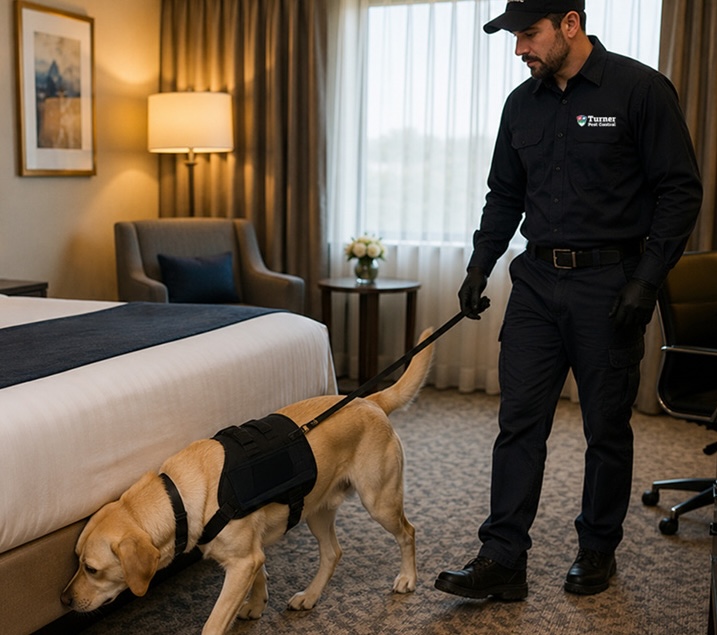
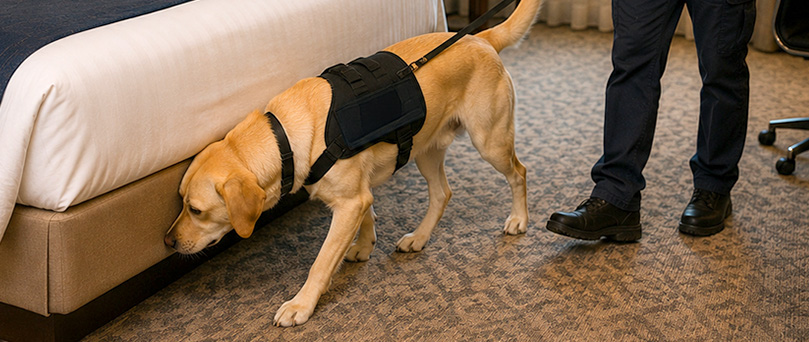
Trained bed bug detection dogs operate on scent rather than sight. A dog’s nose contains roughly 300 million olfactory receptors and can identify the chemical compounds bed bugs produce at a concentration invisible to any human inspector. That means K9 teams catch infestations at the egg and nymph stage, before there’s visible evidence, before populations multiply, and before a problem in one room becomes a problem on an entire floor.
How K9 Inspection Makes for Better Detection
For commercial properties, the operational advantage is significant. A certified K9 team can sweep an entire hotel floor in a fraction of the time it takes a human inspector to pull furniture and turn a mattress in one room. When the dog alerts, the handler documents the exact location, so treatments are targeted, not speculative, and you’re not treating rooms that don’t need it.
Turner Pest Control’s K9 teams are certified through rigorous industry programs requiring both the handler and dog to pass regular proficiency evaluations. Every inspection produces a written report documenting the areas covered, alert locations, and the team’s certification credentials. The records protect your business and demonstrate due diligence to insurers, health departments, and regulatory bodies.
Industries that rely on commercial bed bug inspection:
- Hotels and resorts
- Multi-family apartment communities
- Senior living and assisted care facilities
- Hospitals and healthcare centers
- Universities and student housing
- Office buildings and co-working spaces
Frequently Asked Questions
Do K9 inspections require guests or residents to vacate?
In most cases, no. K9 inspections are designed to work around your operations with minimal disruption. The team typically sweeps vacant rooms and units first, then coordinates brief entries into occupied spaces as needed. Because K9 inspections move quickly relative to traditional visual inspections, the process is usually complete before most guests or residents are meaningfully inconvenienced. Your Turner inspector will coordinate with your property management team in advance to make the process as seamless as possible.
How do I know if my bed bug treatment was successful?
This is where K9 inspection earns its value a second time. A post-treatment K9 inspection provides documented confirmation that no live bed bugs or viable eggs remain in treated areas. If the dog detects continued activity, you’ll know exactly where, and treatments can be adjusted before the infestation rebounds. Most pest management professionals recommend scheduling a K9 clearance inspection 2 to 3 weeks after treatment to allow any remaining eggs time to hatch, ensuring complete elimination.
Can bed bugs survive thermal treatments, and do I need a follow-up inspection afterward?
Thermal treatment is one of the most effective methods for eliminating bed bugs because the heat affects all life stages, including eggs, which some chemical treatments don’t reliably reach. When performed correctly, heat treatment can resolve an infestation in a single application.
That said, heat treatment has limitations. It only affects the areas where sufficient temperature is achieved and maintained, and cold spots around exterior walls, inside dense materials, or in areas with poor air circulation can allow some bugs or eggs to survive. A follow-up K9 inspection 2 to 3 weeks after heat treatment is strongly recommended to confirm that no activity remains. If the dog clears the space, you have documented evidence that the treatment was successful. If it alerts, you’ve caught a problem before it rebounds, which is far better than finding out through a second guest complaint.
How can I stop bed bugs from spreading between units?
The most effective way to interrupt the spread is early detection. This is why proactive K9 inspection schedules matter so much in multi-unit settings. Once an active unit is identified, inspecting immediately adjacent units as a precaution is standard practice. Your pest management provider can also recommend targeted preventive measures, such as door sweeps, mattress encasements, and outlet covers, that reduce the structural pathways bed bugs use to migrate between spaces.
Protect Your Business Before There’s a Problem to Solve
Bed bug infestations don’t announce themselves. By the time guests or residents notice something, the infestation has typically been active for weeks. The commercial properties that manage bed bug risk most effectively are the ones that catch problems before they become crises.
Turner Pest Control’s certified K9 inspection team serves hotels, apartment communities, healthcare facilities, and commercial properties in Orlando and Southeast Florida. Whether you need a one-time inspection, post-treatment verification, or an ongoing protective screening schedule, we’ll build a plan around your property’s specific risk profile.