
Are you being antagonized by ants? Ants are a super annoying nuisance that most homeowners want to get rid of ASAP. If you have been doing some research on getting rid of your ant problem, you’ve likely come across ant baiting and ant spraying, but what’s the difference?
What is Ant Baiting?
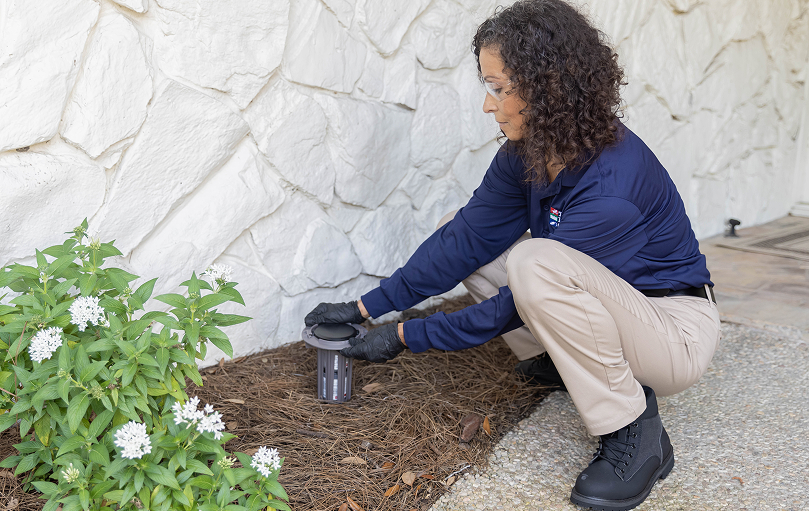
Ant baits contain insecticides mixed with materials that attract worker ants looking for food. Ant baits are a crucial tool to manage ants and the only type of insecticide recommended for most scenarios. Ants are attracted to the bait and recruit other workers to it. Workers carry small portions of the bait back to the nest where it is transferred mouth to mouth to other workers, larvae, and queens to kill the entire colony.
Bait products must be slow-acting so that the foraging ants have time to make their way back to the nest and feed other colony members before they die from the bait. When properly used, baits are by far more effective and safer than sprays. Ant baiting gets to the nest and kills the entire colony. Expertise, time and patience are needed with this method, but is usually the only way to eliminate an entire colony that keeps coming back.
What is Ant Spraying?
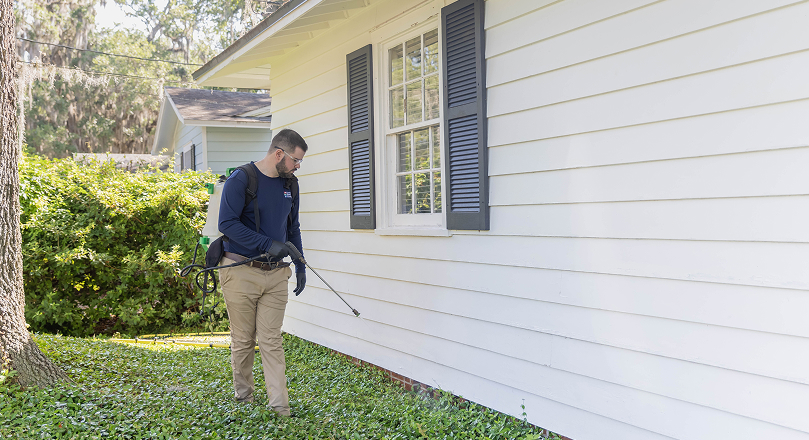
You can use sprays inside to supplement baiting. If the ants in your home have already established an indoor food supply, they may ignore baits. It is best practice to buy an ant spray that is non-repellent to keep the ants from detecting the spray. This inconspicuous method will allow them to walk through the treated areas and pick up the product on their bodies so they can take it back to their colony. A non-repellent spray will not typically kill on contact and will take more time before it starts killing the ants. However, it will ultimately be more devastating to the colony over the long-term as it spreads and infects more ants.
Ant killer sprays kill on contact, but only about 20 percent of an ant colony will step foot outside, possibly subjecting themselves to the spray. This leaves most of the ant colony still intact. This means more frequent re-treatment will be needed to eliminate an ant problem completely. A better spray option is a non-repellent spray that is specifically formulated for outdoor use. Ants are less likely to avoid spots where these sprays are applied and take them back to the colony.
Should I Bait or Use Ant Spray?
You can use baits and sprays in various combinations, but a typical treatment involves spraying outside and baiting inside. This is especially true when treating opportunistic ants that prefer to nest outdoors but may occasionally enter buildings searching for resources.

Key differences
1. Product Formulation
Baits and sprays differ in how they are formulated and applied, and they exhibit several other significant differences. One major difference is longevity of the actual product. Spray products will last a lot longer than baits. It depends on the active ingredient and environmental conditions, but typically, an outdoor spray application will last between four-12 weeks. On the other hand, a bait application may only last a few days before all of the bait is consumed and degraded by rain or being dried out by the sun. It’s also possible for it to be destroyed by non-targets like rodents, birds, and, occasionally, household pets.
2. Effectiveness on Ant Species
Another difference is the effective range. Sprays are generally non-selective and are effective on a wide range of ant species and other predomestic pests such as cockroaches, termites, pillbugs, spiders, and earwigs, beetles, and crickets. On the other hand, the window of activity for baits is a lot more narrow. This is because they are specifically formulated for ants, are consumed mostly by ants, and, as a result, kill only ants. Competition for the bait among different ant species may prevent some species from consuming the bait and limit mortality to the dominant species.
3. Effectiveness and Sanitation
There are also differences between baits and sprays regarding their effectiveness relative to how well they sanitize. Lack of sanitations does not negatively affect sprays, including competing for food sources. The spray’s effectiveness can be improved by the lack of sanitation, like applications made in areas where ants are actively foraging for food (e.g., around garbage cans or landscape plants harboring honeydew-producing insects). Baits, unlike sprays, may be negatively affected by a lack of sanitation. The presence of competing for food resources from honeydew-producing insects or human food may severely limit bait intake and efficacy.
4. Expertise Needed
Another critical difference is how much experience is needed to use each product. Sprays are applied according to standard pesticide labels. They typically require less experience and less knowledge of pest biology and are more forgiving when applied correctly. Baits are far less tolerant and may require a more experienced technician to identify the species of ant, understand the feeding and foraging habits of the different species, and pinpoint the exact nesting locations.
5. Cost
Finally, a significant difference is the cost between the two ant killing products. Similar to sprays, active ingredients cost much more when incorporated into baits. The active ingredient in one popular ant control product costs $1.50 per gram when formulated into a liquid spray formulation. The same active ingredient costs $557 per gram when incorporated into a gel bait. The active ingredient in another commonly used ant product costs $1.20 per gram when formulated as a spray and $26,667 per gram when developed as a gel bait.
Summary
In summary, spray formulations show several attributes that make them highly attractive and suitable for temporary ant solutions, or small infestations of ants.
True ant control treatment plans should include killing the entire colony, which one can usually only achieve by incorporating ant baiting techniques. Just spraying ants with a typical ant spray, will only kill a few, at best, and scatter the colony, making it more difficult to eliminate and thereby prolongs the process. Baiting is the only option that truly gets to the nest and roots out the entire colony.